 相关文章:Ai 5
The Bitter Lesson of BF16 Master Weights: How Small-LR RL Silently Eats Your Updates
TL;DR
- The Trap: Storing master weights in
bfloat16during small-learning-rate RL (lr = 5e-7) silently freezes most of the model. For a typical weight $|w| \approx 0.02$, the smallest stepbf16can resolve (half-ULP) is $6.10 \times 10^{-5}$—over $120\times$ larger than a5e-7Adam update. Every step rounds straight back to the original value.- Why It Goes Unnoticed: Training does not crash or flatline. Tiny-magnitude weights ($|w| \le 10^{-4}$) and near-zero biases have much smaller ULPs and do update—causing reward and easier benchmarks (GSM8K:
35.25% → 57.01%) to climb slowly while harder reasoning (MATH500:35.01% → 35.01%) stays frozen at the exact untrained baseline.- The Fix: Restoring standard
fp32master weights (keepingbf16forward/backward compute) beat 929 steps ofbf16training by Step 100, finishing+7.2points higher on MATH500 (42.25%) and+21.3points higher on GSM8K (78.32%), at the cost of~7 GB/GPUextra memory and+20%step time.
The blog is co-authored with Gemini Carbon.
Rich Sutton’s Bitter Lesson argues that general computation ultimately beats clever human priors. In post-training engineering, there is a humbler bitter lesson: what makes or breaks three weeks of reinforcement learning experiments is often not your advantage estimator or reward shaping—it is four lines of overlooked dtype configuration in a shell script.
Specifically: bfloat16 master weights combined with RL-scale learning rates (1e-7 to 1e-6) silently turn off the optimizer on >95% of your parameters—while producing training curves that merely look like “slow convergence.”
1. The Mystery: Rising Reward, Frozen Reasoning
We were running D1-style GRPO reinforcement learning on a 7B diffusion language model (Dream-v0-Instruct-7B, response length 128, lr = 5e-7, 929 steps / 1 epoch) using a verl-based FSDP training stack.
When the bf16 baseline finished all 929 steps, the evaluation numbers looked puzzling:
| Checkpoint | MATH500 | GSM8K | Training Reward |
|---|---|---|---|
Untrained Base (step 0) | 35.01% (174/497) | 35.25% (465/1319) | ~0.352 |
After 929 Steps (bf16, eval at step 900) | 35.01% (174/497) | 57.01% | ~0.523 |
At first glance, nothing screamed “broken”:
- Training reward climbed steadily from
0.352to0.523. - GSM8K jumped by +21.8 percentage points.
- Only MATH500 appeared stuck—which was easy to rationalize away as “128 response tokens is simply too short for competition math.”
2. The Smoking Gun: Measure Step 0 Before Explaining Step 900
What broke that illusion wasn’t the training curve—it was running a strict val-before-train (Step 0) evaluation with the exact same decoding pipeline and placing it side-by-side with Step 900.
On MATH500, the untrained base checkpoint scored 35.01% (174/497)—matching the post-RL model at Step 900 to the exact integer count.
When a model undergoes 929 steps of policy gradient optimization, improves by 22 points on GSM8K, yet outputs the exact same score on MATH500 as an untouched checkpoint, “the task is too hard” stops being the most plausible hypothesis. A more unsettling question takes over: did the weights actually move?
3. The Mechanism: Mantissa Swamping in bfloat16
Tracing the resolved Hydra config uncovered four overrides buried inside a 200-line launch script:
| |
They looked like standard flags to enable fast bf16 tensor-core compute. In reality, setting model_dtype=bfloat16 forced three critical optimizer quantities down to 16 bits:
| Component | Pure bf16 Override (Buggy Baseline) | Standard Mixed Precision (fp32 Control) |
|---|---|---|
| Master Weights (updated by Adam) | bfloat16 | float32 |
| Adam 1st & 2nd Moments ($m_t, v_t$) | bfloat16 | float32 |
| Gradient All-Reduce / Buffers | bfloat16 | float32 |
| Forward / Backward MatMuls | bfloat16 | bfloat16 |
Engineers often remember that fp16 (5 exponent bits) suffers from gradient underflow, whereas bf16 shares fp32’s 8-bit exponent range ($\sim 10^{-38}$ to $10^{38}$) and needs no loss scaling. That solves dynamic range for gradients, but it sacrifices mantissa precision: bf16 has only 7 explicit fraction bits (8 precision bits including the implicit leading 1), compared to fp32’s 24 precision bits. The failure mode in bf16 master weights isn’t gradient underflow—it is addition swamping ($w \oplus \Delta w = w$).
The ULP Math: When $w + \Delta w = w$
In AdamW, the parameter update magnitude on well-conditioned coordinates is governed directly by the learning rate:
$$|\Delta w_t| \approx \eta \cdot \frac{|\hat{m}_t|}{\sqrt{\hat{v}_t} + \epsilon} \approx \eta = 5 \times 10^{-7}$$
For a floating-point number $w$ in $[2^e, 2^{e+1})$, bfloat16’s Unit in the Last Place (spacing between adjacent representable numbers) is $\text{ulp}_{\text{bf16}}(w) = 2^{e - 7}$. Under IEEE-754 round-to-nearest-even, any update smaller than half an ULP ($2^{e - 8}$) is deterministically rounded away to zero:
| Weight Magnitude $\lvert w \rvert$ | Binary Bin $[2^e, 2^{e+1})$ | bf16 ULP ($2^{e-7}$) | Rounding Threshold ($\frac{1}{2}\text{ULP}$) | Does lr = 5e-7 Register? |
|---|---|---|---|---|
0.02 (typical init $\sigma$) | $e = -6$ | $1.22 \times 10^{-4}$ | $6.10 \times 10^{-5}$ | ❌ No ($122\times$ too small) |
0.001 ($10^{-3}$) | $e = -10$ | $7.63 \times 10^{-6}$ | $3.81 \times 10^{-6}$ | ❌ No ($7.6\times$ too small) |
0.0001 ($10^{-4}$) | $e = -14$ | $4.77 \times 10^{-7}$ | $2.38 \times 10^{-7}$ | ✅ Yes (barely) |
Look at what happens on every optimizer step for a standard weight $|w| \approx 0.02$:
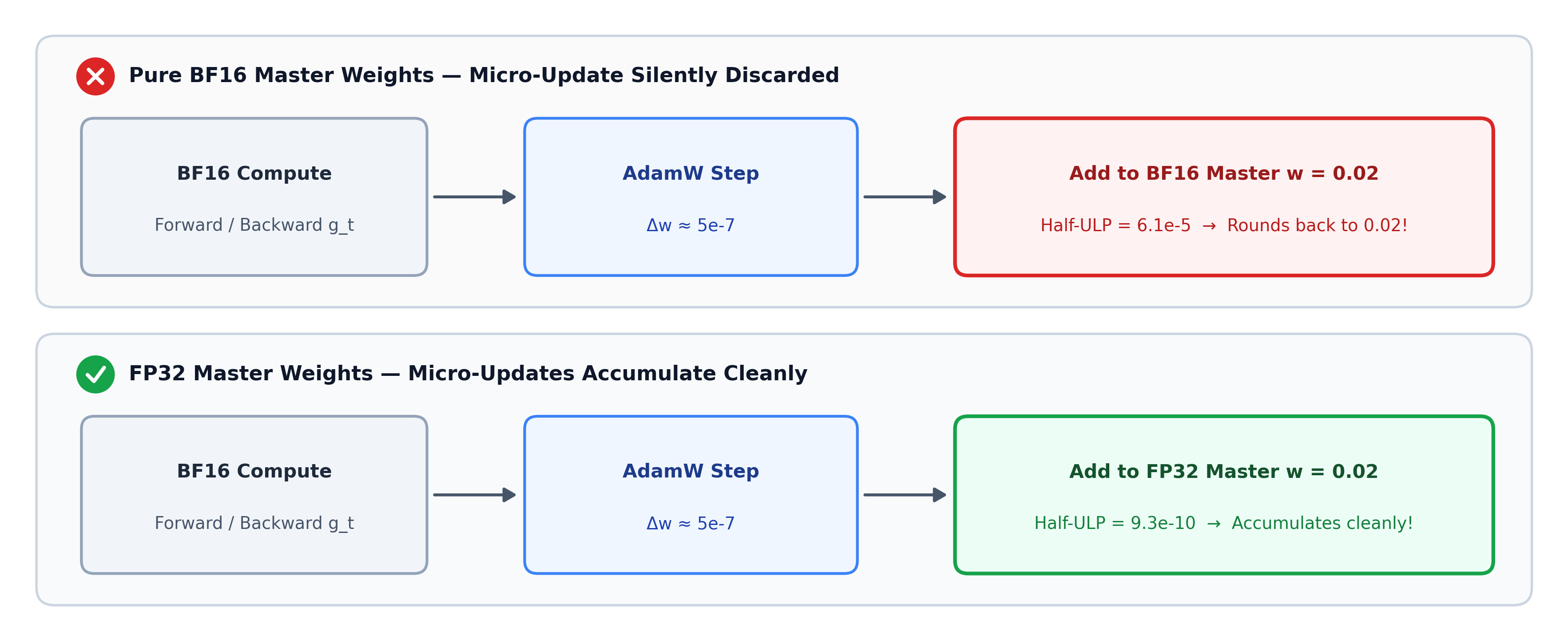
Because deterministic rounding has no memory across steps, failing to clear half-ULP once means failing forever: 929 consecutive updates of 5e-7 sum to exact zero.
Why Did GSM8K Still Improve by 22 Points?
Notice the third row of the ULP table. Floating-point spacing scales with magnitude: parameters near zero ($|w| \le 10^{-4}$), small normalization shifts, and near-zero tail entries of projection matrices do have ULPs fine enough to absorb 5e-7 updates.
Consequently, bf16 master weights didn’t freeze 100% of the network—they created selective, magnitude-biased plasticity:
- Large structural weights ($|w| \sim 10^{-2}$) carrying core reasoning circuits were 100% frozen.
- Tiny weights ($|w| \le 10^{-4}$) remained trainable, acting like an accidental, unstructured micro-adapter that improved answer formatting and basic GSM8K arithmetic while leaving deeper MATH500 reasoning untouched.
Ironically, the upstream verl worker file (verl/workers/dllm_fsdp_workers.py) already contained an explicit warning comment right above model initialization:
| |
Those four Hydra overrides bypassed that safeguard.
4. The Controlled Experiment: Step 100 Beats Step 929
We ran a strict single-variable ablation: removing only the four bfloat16 FSDP overrides so master weights, moments, and gradient reductions defaulted back to fp32, while keeping every hyperparameter identical (bsz = 16, rollout n = 8, lr = 5e-7, prompt 512, response 128, 64 rollout diffusion steps, 128 eval steps at temp = 0.2, top_p = 0.95, 929 total steps).
Head-to-Head Evaluation Trajectory
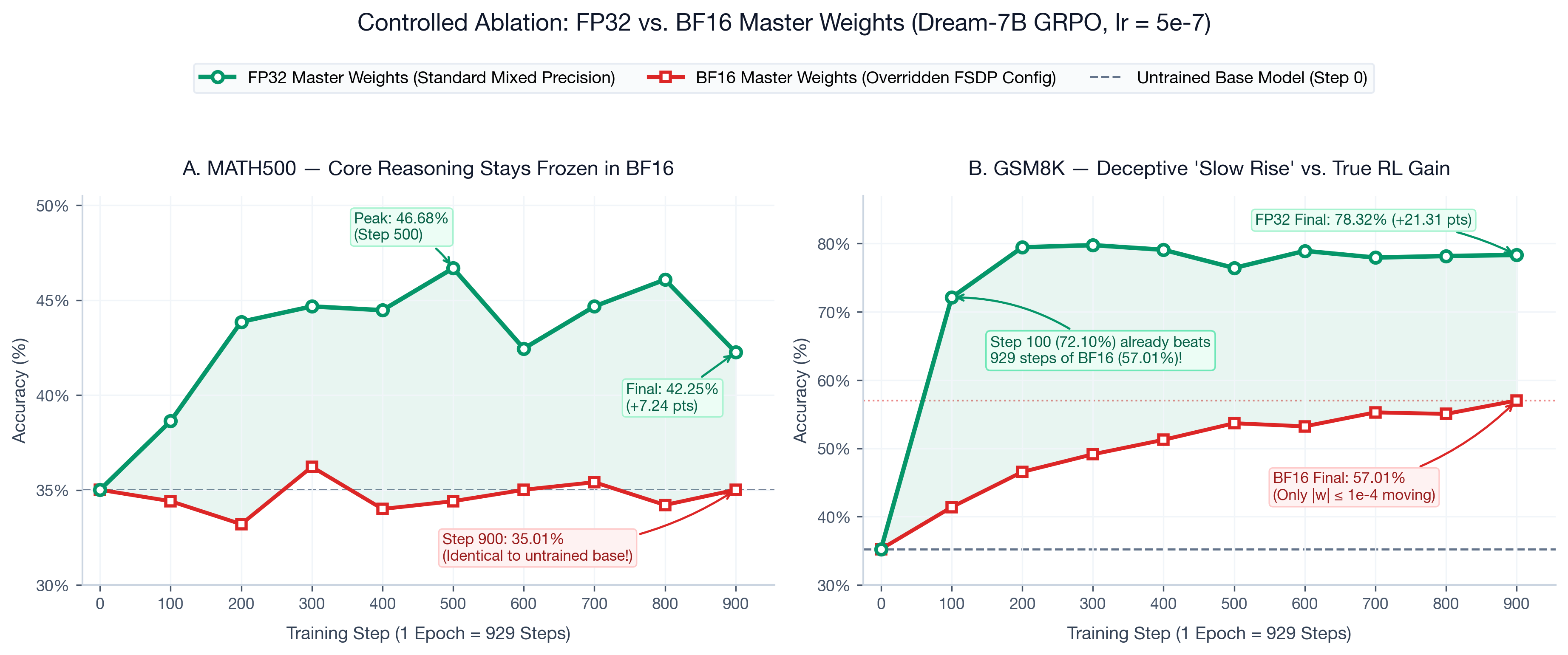
| Step | bf16 Master Weights | fp32 Master Weights | Delta (MATH500 / GSM8K) |
|---|---|---|---|
| 0 (Base) | 35.01 / 35.25 | 35.01 / 35.25 | 0.00 / 0.00 |
| 100 | 34.41 / 41.39 | 38.63 / 72.10 | +4.22 / +30.71 |
| 200 | 33.20 / 46.55 | 43.86 / 79.45 | +10.66 / +32.90 |
| 300 | 36.22 / 49.13 | 44.67 / 79.76 | +8.45 / +30.63 |
| 400 | 34.00 / 51.25 | 44.47 / 79.08 | +10.47 / +27.83 |
| 500 | 34.41 / 53.68 | 46.68 / 76.42 | +12.27 / +22.74 |
| 600 | 35.01 / 53.22 | 42.45 / 78.92 | +7.44 / +25.70 |
| 700 | 35.41 / 55.27 | 44.67 / 77.94 | +9.26 / +22.67 |
| 800 | 34.21 / 55.04 | 46.08 / 78.17 | +11.87 / +23.13 |
| 900 (Final) | 35.01 / 57.01 | 42.25 / 78.32 | +7.24 / +21.31 |
Three takeaways jump off the curves:
- 100 steps of
fp32beat 929 steps ofbf16: By Step 100, thefp32run reached38.63%on MATH500 and72.10%on GSM8K—already3.6and15.1points ahead of wherebf16finished nine times later. - Massive signal-to-noise: On GSM8K’s 1,319 test problems, binomial standard error is ~1.1–1.3 percentage points; a +21 to +33 point gap is an unmistakable regime change, not seed noise. (We deliberately judged via full validation passes rather than single-batch training rewards, which jittered wildly between
0.500and0.805from batch to batch.) - Predictable systems footprint:
- Peak GPU Memory:
55.8 / 70.7 GB(bf16) →61.1 / 78.0 GB(fp32), an increase of ~5.3–7.3 GB/GPU, matching the analytical cost of shardedfp32parameters and Adam states. - Throughput:
64 s/step→76 s/step(~19% slower)—a bargain compared to burning 100% of GPU hours on frozen weights.
- Peak GPU Memory:
5. Why Pre-Training Survives While RL Gets Crushed
Why did this exact bug hide for three weeks—and why do some pure-bf16 training scripts appear to work in other settings?
Because whether bf16 eats your updates depends entirely on your learning-rate regime:
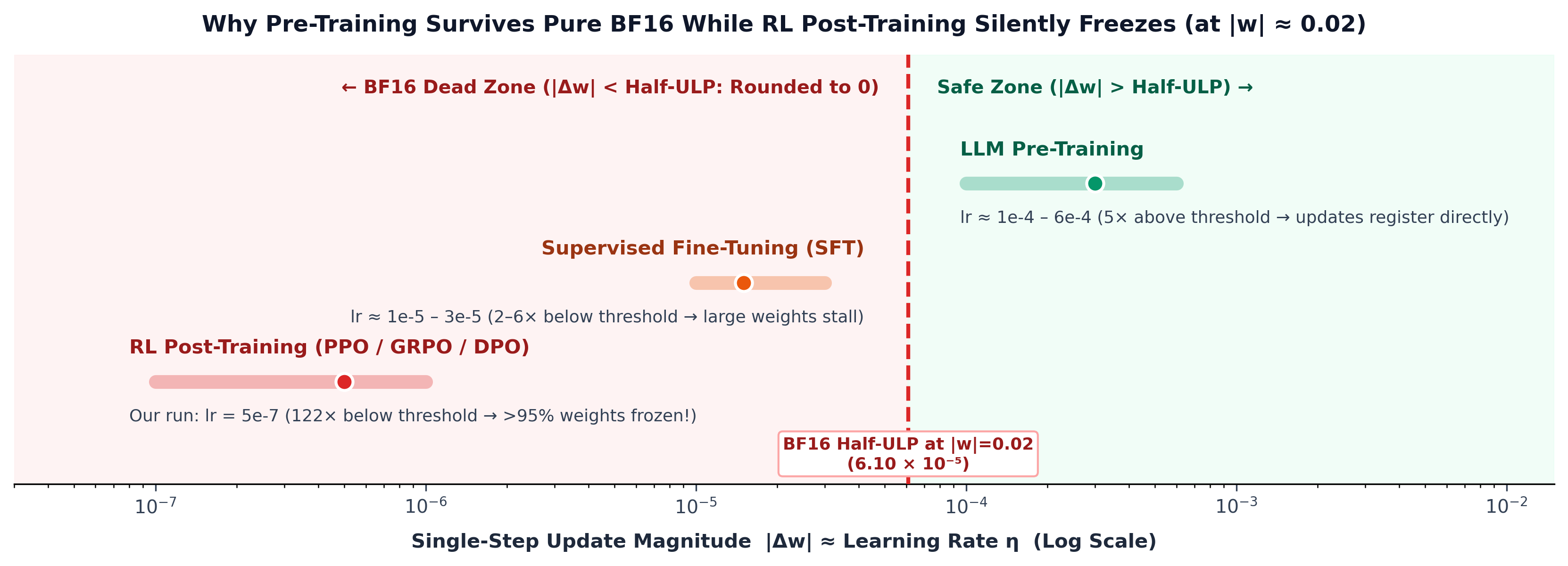
In RL post-training (PPO, GRPO, DPO, REINFORCE), learning rates almost always live in the 1e-7 to 2e-6 band to prevent KL divergence collapse and catastrophic forgetting. That places RL two full orders of magnitude inside bf16’s dead zone. Combined with rising reward curves (from near-zero weights adapting) and missing Step-0 baselines, a broken config masquerades effortlessly as an algorithmic ceiling.
6. What If You Truly Cannot Afford FP32 Memory?
On a 7B model under FSDP, spending an extra ~7 GB/GPU for fp32 master weights and optimizer states is almost always the right trade-off. But what if you are post-training a 70B+ model near VRAM limits? You have three mathematically sound options instead of naive bf16 rounding:
| Approach | Extra Optimizer VRAM | How It Avoids Mantissa Swamping | When to Use |
|---|---|---|---|
Standard Mixed Precision (fp32 master $w$ + fp32 Adam) | Baseline (12–16 B/param sharded) | Exact accumulation down to $\sim 10^{-9}$ | Default choice whenever FSDP / ZeRO-3 memory allows. |
fp32 Master Weights + 8-bit / bf16 Moments | Saves 4–6 B/param vs. full fp32 | Keeps fp32 precision on $w \leftarrow w - \Delta w$ while compressing $m_t, v_t$ | Memory-tight RL runs where FSDP shards fit fp32 master weights but not fp32 Adam states. |
| BF16 + Stochastic Rounding (SR) | 0 extra bytes (pure bf16) | Rounds up by 1 ULP with probability $p = \lvert \Delta w \rvert / \text{ulp}(w)$ (e.g., 0.41% per step), making $\mathbb{E}[\Delta w_{\text{SR}}] = \Delta w$ unbiased | Custom fused Triton / TorchAO kernels on extreme memory budgets. |
| BF16 + Kahan Summation | +2 B/param (one bf16 error buffer) | Tracks rounding residual $c_t$ separately until accumulated error crosses $1\text{ ULP}$ | Pure-16-bit pipelines without stochastic-rounding kernel support. |
The key rule: never apply deterministic round-to-nearest bf16 updates directly to master weights at $\eta < 10^{-4}$ without either an fp32 master copy, an error-compensation buffer, or stochastic rounding.
7. Practical Checklist & Open Questions
- Always run
val-before-train(step 0) using the exact in-loop evaluator and put Step 0 alongside your final step in every table. Judge RL progress by delta over Step 0, never raw reward curves alone. - Keep master weights in
fp32by default. Leave FSDP’smodel_dtypeunset (defaulting tofp32) and restrictbf16to forward/backward autocast compute. - Verify the resolved config and VRAM delta, not the shell script. Check the printed Hydra/FSDP dump in job logs and confirm GPU memory reflects
fp32optimizer states—an unexpectedly “lean” memory footprint during RL is a red flag, not a free optimization. - Change one variable per ablation. Keep eval frequency, checkpoint cadence, and rollout sampling identical when debugging training dynamics.
Open Caveats
- Master weights vs. second moments: Switching
model_dtypefrombf16tofp32simultaneously upgraded master weights, Adam moments ($m_t, v_t$), and gradient reduction buffers. While ULP swamping on master weights is sufficient on its own to freeze $|w| \approx 0.02$ atlr = 5e-7, running an intermediatefp32-master-weights + bf16-momentsconfiguration would cleanly isolate any secondary precision loss in $v_t$. - Breadth across sequence lengths & seeds: This controlled comparison was verified at full 929-step length on
response_len = 128(lr = 5e-7) with a single seed. Although a+21to+33point GSM8K shift dwarfs the ~1.3-point evaluation standard error, replicating across longer response horizons (e.g., 256/512) will quantify how much ceiling was left on the table in longer-context runs.